War Of 1812 Schooners Below
Ghost Schooners of Lake Ontario: Hamilton and Scourge, and the Night They Rolled Over
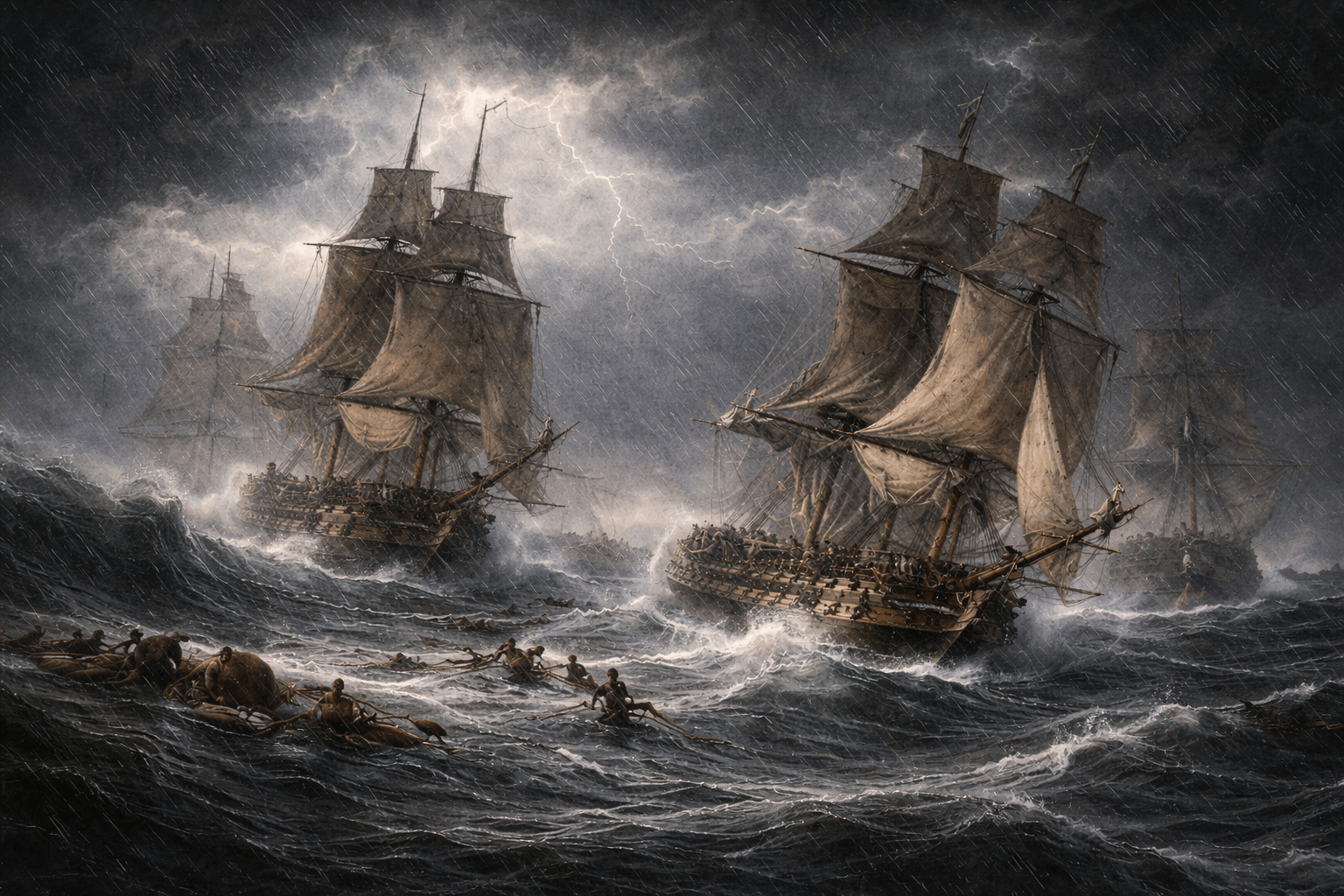
There is a particular kind of quiet that comes before weather turns on the Great Lakes. Not calm exactly, more like the lake is holding its breath. Ned Myers remembered that stillness on Lake Ontario in early August 1813. In James Fenimore Cooper’s Ned Myers; or, A Life Before the Mast (1843), Myers describes an evening so clear that “not a cloud” was visible and the lake lay “as smooth as a looking glass.”
But the sinking of Hamilton and Scourge is not only a storm story. It is a ship story first.
If you want to understand why two vessels could capsize so quickly, you have to start earlier, before war names, before uniforms, before the squall. You have to meet them as they began life: Diana and Lord Nelson.
Before Hamilton and Scourge: Diana and Lord Nelson
Both schooners were originally merchant vessels, built for trade and transport, then adapted into wartime service when the War of 1812 demanded speed and availability more than ideal naval design. Parks Canada’s designation text is direct: they were designed as merchant schooners and modified for military purposes once hostilities began.

That original purpose matters because merchant schooners and war schooners are built around different priorities.
A merchant schooner is meant to carry cargo efficiently, sit relatively light, and do its work in a predictable way. A war vessel, even a small one, needs to carry concentrated weight, guns and shot, extra crew, and still remain safe when pressed hard in bad weather. Converting a merchant hull can be done, but it changes the vessel’s balance and narrows the margin for recovery when things go wrong.
A modern Parks Canada underwater archaeology description notes that these ships were merchant craft converted into warships for use on Lake Ontario.
Their earlier identities are still literally on the bow
Archaeology makes this tangible in a way documents cannot.
The wreck of Scourge still carries a bow figurehead depicting Lord Nelson, now mussel covered but recognisable in remotely operated vehicle imagery. This is not metaphor. The ship changed hands and name, but the older identity remained.
A scholarly synthesis of the wreck surveys likewise notes that Scourge, originally Lord Nelson, displayed the striding figure of Admiral Horatio Nelson on the prow, a striking reminder that the vessel’s original merchant identity persisted into its naval life.
Hamilton’s earlier identity is preserved as well. National Geographic notes that Hamilton’s figurehead depicts Diana, the Roman goddess of hunting, tying the wreck back to her earlier name and merchant origin.
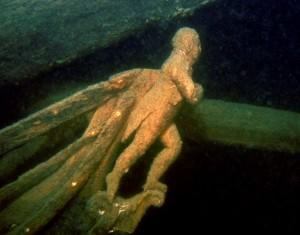
So when you picture these ships on the lakebed, you are also looking at the visible remains of their first lives.
Conversion, tenderness, and the stability problem no one could fully solve
Converted merchant schooners were modified for combat by adding armament and altered upper works. Those changes could make vessels top heavy and more sensitive to sudden gusts.
A scholarly synthesis of survey work discusses the bulwarks as part of the merchant to warship modification, describing evidence that the construction was rough and emphasising the consequences of conversion for stability.
Myers gives a sailor’s version of the same issue. He described Scourge as “tender,” so tender that the crew took special precautions because the craft did not behave safely in a blow.
In practical terms, tenderness means a vessel heels quickly and has less ability to recover, especially if weight shifts and water comes aboard. That vulnerability becomes critical in the kind of local, concentrated squall the Great Lakes are famous for.
The patrol and the calm: off Port Dalhousie, August 1813
By early August 1813, the American squadron was operating off the Niagara region. Parks Canada places the fleet off Port Dalhousie when the storm hit.
Myers’ account is valuable because it captures sequencing. He describes waking to rain in near darkness. Then lightning and thunder. Then a rush of wind so sudden it seemed to smother the thunderclap itself.
This is where ship design and weather meet.
A sudden squall hits sail area hard. If the ship is already top heavy from conversion, the heel comes quickly. Once the rail drops and water is on deck, the situation compounds: water adds weight to the low side, loose mass shifts, and the vessel loses what little righting ability remains.
Myers describes men pinned to leeward beneath guns and heavy objects as Scourge fell over. That is not only horror, it is a clue about mechanics. When heavy objects shift downhill as the deck angles, the centre of gravity moves with them, locking the heel into a capsize.
He also describes water pouring down below “like a sluice.” Downflooding is often the point of no return. Even if a vessel tries to recover, it recovers into a hull already filling.
Parks Canada summarises the outcome: both vessels capsized and sank during the squall, with more than 50 lives lost.
How fast was it
It is important not to over dramatise. The evidence is dramatic enough.
The wrecks lie deep, about 90 metres down, upright and remarkably intact. That intactness implies a rapid sinking, not a long drawn out breakup at the surface.
Myers described the critical phase as happening in less than a minute, and the full disappearance occurring within minutes. Memory is not a stopwatch, but the material context supports the basic point: there was little time to respond.
What the wrecks tell us, beyond the storm
The wrecks were discovered in 1973 and are now recognised as National Historic Sites because of their preservation and what they reveal about early 19th century shipbuilding, naval warfare, and life aboard small vessels on the Great Lakes.
Parks Canada notes that the depth and isolation initially limited disturbance, but that advances in diving and the spread of invasive quagga mussels increased risk, prompting major documentation and monitoring efforts between 2007 and 2009 using tools such as side scan sonar and remotely operated vehicles.
This matters because underwater archaeology is not only about locating wrecks. It is about recording them responsibly and preserving them as cultural heritage and, in this case, as war graves.
Why their earlier identities belong at the centre of the story
If you tell this story as “a squall sank two warships,” you miss the deeper mechanism.
These were merchant schooners, Diana and Lord Nelson, asked to carry war weight and war demands. Their bows still carry those original identities, preserved underwater in figureheads that outlasted the renaming.
When the lake turned, the ships did what vulnerable, converted hulls can do under sudden force: they heeled too far, too fast, with too little margin to right themselves.
And now, on the lakebed, the ships sit as a rare kind of archive, a place where storm, design, wartime improvisation, and human testimony align in wood, iron, and silence.diagnosis from lived experience.
This is the part many retellings skip. The storm did not have to be a legendary hurricane. A short, violent squall can be enough when a ship’s design and modifications have narrowed its options.
The patrol, the calm, and the physics of a capsize
Parks Canada places the fleet off Port Dalhousie on the night of 7 to 8 August 1813. The key detail is “sudden”: the squall arrives fast, before a tired crew can reduce sail, secure gear, and prepare the ship to meet it. (Parks Canada)
Myers’ account, as recorded by James Fenimore Cooper, gives us something rarer than official reporting: deck level sequencing. He describes waking to heavy drops of rain in near darkness, with the lake previously so calm there was “not being a breath of air, and no motion to the water”. Then lightning, thunder, and a rush of wind arrives almost as a single blow.
From an interpretive standpoint, this matches what Great Lakes sailors know well: local squalls can behave like a concentrated downward blast of wind followed by a sudden lateral surge. On a small schooner carrying extra top hamper and deck weight, the sequence is deadly:
Water comes aboard early because the ship heels sharply and the rail drops close to the surface.
Once water is on deck, it increases the weight on the low side and reduces the ship’s ability to right itself.
Loose or semi secured mass shifts. Myers describes men trapped to leeward under guns, shot boxes, shot, and other heavy gear that “had gone down as the vessel fell over”. That shift is not just injury and chaos, it is the centre of gravity sliding across the deck, locking the heel into a capsize.
Downflooding follows. Open hatches, companionways, and gun ports become pathways for water. Myers describes water pouring down into the cabin “like a sluice”. At that point, even if a schooner momentarily attempts to recover, it is recovering into a hull that is already filling.
He estimates the critical phase happened in less than a minute and that only a few minutes passed from impact to the schooner disappearing. Whether every second is exact is less important than what the account conveys: there was no drawn out battle with the lake. It was a near instant systems failure driven by wind force, compromised stability, and shifting mass.
The Hamilton went down in the same event, close enough in time and place that nearby vessels could rescue some survivors but not reverse the outcome. Parks Canada summarises the loss as over 50 lives, and National Geographic describes 16 saved while at least 53 perished. Those numbers vary slightly across tellings because survival and muster records are messy, but the scale of the disaster is consistent. (Parks Canada)
Ned Myers matters, but he is not the whole story
Myers is invaluable because he gives us the only real firsthand texture of the sinking, the human scale of a capsize, the sounds, the helplessness, the split second decisions that either connect you to a boat line in the dark or do not.
At the same time, we should read the account as a memory shaped by trauma and later retelling, edited and presented through Cooper’s pen. That does not diminish it. It simply means we use it the way archaeologists use oral histories and documentary sources: not as a perfect instrument, but as evidence that becomes stronger when it aligns with environmental plausibility and with what the wrecks themselves show.
Rediscovery, preservation, and what the wrecks still hold
The story does not end in 1813. The wrecks were discovered in 1973, lying about 90 metres down, north of Port Dalhousie. Parks Canada calls them outstanding archaeological records of shipbuilding and naval warfare for their time. (Parks Canada)
National Geographic describes them resting upright and remarkably intact, masts included, about 1,500 feet apart in roughly 300 feet of water. That matters because intactness preserves context. It is not just “a ship on the bottom”. It is a time capsule of how equipment was stowed, what stayed secured, what shifted, and what the crew was doing in the moments before loss. (National Geographic)
Modern archaeology around Hamilton and Scourge also shows how a site can be both protected and threatened at once. For decades the depth and isolation limited disturbance, but Parks Canada notes that improved technical diving access and the spread of invasive quagga mussels changed the risk profile. From 2007 to 2009, Parks Canada and partners used remote recording methods such as side scan sonar and remotely operated vehicles to document the wrecks and assess impacts. (Parks Canada)
This is an important point for any archaeological discussion: preservation is not passive. Even a deep freshwater site needs monitoring, documentation, and a management strategy because the conditions that protected it in 1973 are not necessarily the conditions that will protect it tomorrow. (Parks Canada)
Why this matters beyond shipwreck fascination
Hamilton and Scourge sit at the intersection of improvisation and consequence. They remind us that wartime necessity often forces technology into roles it was never designed for, and nature does not negotiate with urgency. They also remind us what underwater archaeology can do at its best: hold together engineering, environment, human testimony, and material evidence without flattening any of them into a tidy legend. (Parks Canada)
If you want a single image to keep in mind, make it this: two merchant hulls made into warships, carrying more weight and expectation than their lines were built to bear, meeting a sudden Lake Ontario squall in darkness, and leaving behind a remarkably complete archive on the lakebed that still demands careful stewardship. (Parks Canada)nt she was never designed to carry.
That tenderness matters because a sudden squall does not negotiate.
The squall, the heel, the minute that ended everything
Myers fell asleep at his gun. He woke to rain. Then came the shift from annoyance to terror so fast it is hard to read without feeling your body tense.
A lightning flash. Immediate thunder. And then, “a rushing of winds” that “smothered” the thunderclap. Myers sprang for lines, trying to free sail and force the schooner to turn downwind. He is specific about the sequence: jib sheet, topsail sheet, clew line, shouting for the helm “hard down.” (web.seducoahuila.gob.mx)
And then the sentence that tells you physics has already won: “The water was now up to my breast, and I knew the schooner must go over.”
This is the moment where the “merchant vessel turned warship” problem becomes fatal. A squall hits with intense force on sail area. If the ship’s centre of gravity is higher than it ought to be, and if heavy deck gear and armament are ready for action rather than secured for heavy weather, the heel becomes a cascade. Myers describes men pinned to leeward beneath guns and heavy objects as the vessel fell over. It is not only drowning, it is crush injury, entrapment, and darkness.
As for Hamilton, Myers admits he did not witness her loss directly, but he records what he learned afterward: reports that her topsail sheets were stoppered and halyards racked. (online-literature.com) Even if sailors disagree about whether that was “right” or “wrong,” he concludes it likely made little difference in a gust like that. (online-literature.com) The squall was simply too sudden, too concentrated, too violent.
Parks Canada summarizes the outcome without drama: a sudden squall off Port Dalhousie, both ships capsized and sank in the early morning of August 8, 1813, with more than 50 lives lost. (Parks Canada)
Why this wreck is archaeological gold, not just tragedy
What happened next is why archaeologists still speak of Hamilton and Scourge with a kind of reverence.
They went down deep, cold, and fast. The wrecks lie in roughly 90 metres of water, standing intact on the lakebed. (Parks Canada) That depth and environment helped preserve them as time capsules of early 19th century naval life, rigging, guns, shipboard objects, and the ordinary mess of human routine frozen in place.
They were located with sonar in 1973, and later expeditions confirmed and documented the site. (Parks Canada) The discovery story is part science and part persistence: Canadian Geographic notes Daniel Nelson’s role in finding the wrecks, and how the site drew major technical and documentary interest over time. (canadiangeographic.ca) Library of America’s War of 1812 feature also highlights the 1973 sonar location and later underwater documentation efforts.
Parks Canada’s more recent work reads like a field report from the deep: side scan sonar, precisely mapped debris fields, remotely operated vehicles, and long term monitoring, including the very real problem of invasive quagga mussels gradually covering what we are trying to study. (Parks Canada) Underwater archaeology is never only about “finding.” It is about recording, protecting, and accepting that preservation is an active job, not a passive hope.
Cooper, Myers, and the strange power of one survivor’s voice
Without Ned Myers, Hamilton and Scourge would still matter. But they would feel different.
Cooper’s book is unusual because it is both literature and source material. Library of America describes how Cooper composed the work as if it were Myers speaking in his own voice, after the two reconnected in 1843 and Cooper began shaping Myers’ memories into narrative. (storyoftheweek.loa.org) That matters to historians: it is not a logbook entry or an officer’s report. It is a foremast sailor telling you how the deck felt, how the sky sounded, how quickly a ship can become a trap.
Myers gives us details that official summaries rarely preserve: the choice not to secure guns because the night looked calm, the practical argument about readiness, the instant shift from quiet to chaos, and the terrifying speed with which water and weight take control. (web.seducoahuila.gob.mx) In a disaster that lasted minutes, the only first hand account becomes its own kind of artefact.
What the lake kept, and what it returned
Hamilton and Scourge are often called “ghost ships,” but that phrase can be too easy. These are also war graves. They are also engineering lessons written in timber and iron. And they are also archaeological records so complete that Parks Canada calls them outstanding examples of War of 1812 vessels and a “wealth of archaeological information.” (Canada)
A merchant schooner was never meant to carry the posture of a warship in a sudden Lake Ontario squall. When the wind arrived, the compromise showed itself in the simplest way a lake can deliver truth: by rolling the ship past the point where skill can recover it.
And then, 160 years later, sonar found them again, upright in the dark, still telling their story to anyone willing to do the slow, careful work of listening. (Parks Canada)