New Ground: Recent Archaeology in Canada
Recent Archaeological Sites in Canada That Are Worth Our Attention
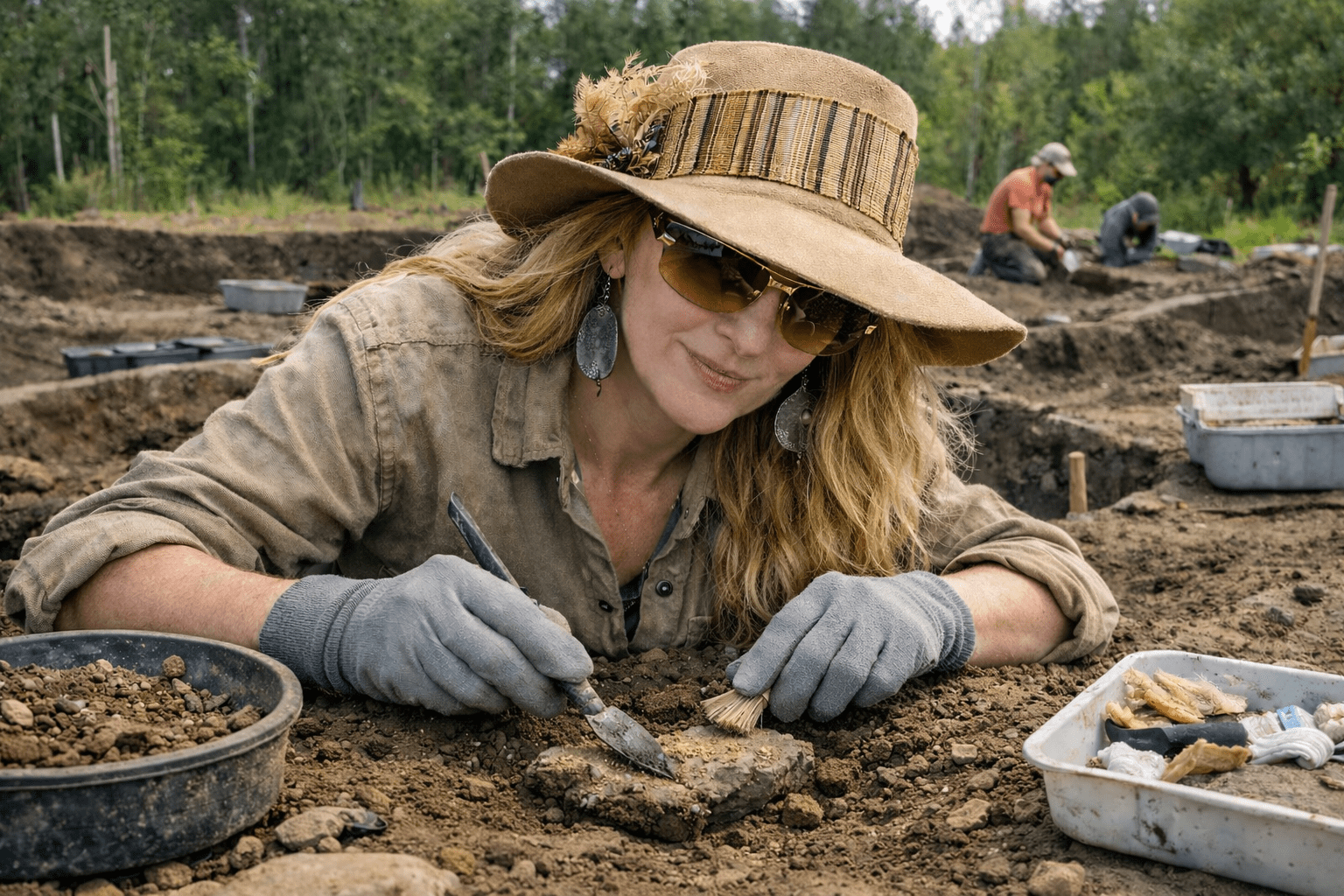
When people say “a new discovery,” what they usually mean is that something has become newly documented, newly interpreted, or newly visible. Archaeology is rarely a single dramatic moment. It is fieldwork, survey, careful recording, collaboration with communities, and then the slow work of figuring out what the evidence can actually support.
With that in mind, these are a few recent Canadian finds and research updates that stand out, not because they are flashy, but because they add real texture to how we understand place, movement, trade, and survival in very different regions of the country.
Âsowanânihk in Saskatchewan, an 11,000 year old settlement with a very specific geography
In February 2025, researchers working with Sturgeon Lake First Nation and the University of Saskatchewan described Âsowanânihk, meaning “a place to cross,” as an approximately 11,000 year old pre contact settlement along the North Saskatchewan River, near Prince Albert. The reporting points to evidence such as stone tools, hearths, and faunal remains, and to the role of riverbank erosion in bringing material to light.
From an interpretive standpoint, what matters here is not just age. It is what a “crossing place” implies about landscape knowledge and repeated use. A river crossing is not incidental. It is a decision point, a meeting point, a reliable feature in a world where everything else can be seasonal. If the site continues to support long term or repeated occupation, it strengthens the broader picture of early land use as structured and strategic, not simply drifting across a blank map.
Farwell Canyon in British Columbia, where a post landslide survey revealed dozens of additional sites
In 2025, survey work in the Farwell Canyon area of the Chilcotin region identified 70 additional archaeological sites spanning roughly 4,000 years, including numerous pre contact villages and pit house features associated with Secwépemc history. This was reported in the context of cultural heritage assessment after major landscape disruption, which is increasingly part of archaeological reality in Canada. (archaeology.org)
This kind of result is a reminder of two things archaeologists already know, but the public often forgets.
First, site density can be high in places that do not look “occupied” to an outsider. Villages, seasonal settlements, and travel corridors are often embedded in the same favourable locations for millennia.
Second, natural events can force urgent documentation. When slopes fail or rivers cut new channels, the ground can reveal heritage and destroy it in the same season. The discovery is not the end point. The real work is triage, recording, and long term stewardship.
Ferryland, Newfoundland, rare wampum beads and the problem of imagining early colonies as isolated
In July 2025, excavations at the Colony of Avalon site in Ferryland uncovered seven wampum beads, a find described as rare for Newfoundland and Labrador. Accounts emphasise wampum as Indigenous made shell beads with ceremonial and diplomatic weight, and note that their presence at a seventeenth century English colonial site adds evidence for long distance exchange networks and complex Indigenous European interactions. (archaeology.org)
Academically, the value of this discovery is that it forces precision. If wampum is present, we have to ask how it arrived, through whom, and in what context. Was it direct exchange. Was it moving through intermediaries. Was it a curated object with meaning that outlasted the moment it was made. These are the kinds of questions where a small artefact can open a wide historical field, as long as we resist the urge to turn it into a simple story.
A Lake Ontario shipwreck found upright at depth, with masts still standing
In late 2025, divers near Toronto reported a remarkably intact shipwreck in Lake Ontario at around 100 metres depth, sitting upright with both masts still standing. Coverage indicates the team, led by Ontario Underwater Council president Heison Chak, was initially searching for a different wreck, and that preliminary observations suggested an early nineteenth century vessel, though further documentation and sampling would be needed for confident identification and dating. (smithsonianmag.com)
For maritime archaeology, this is significant because intact context is everything. An upright wreck with standing masts, preserved rigging, and coherent structure is a rare opportunity to study construction and technology from a period that is not always well represented in surviving documentation. It is also a reminder that Great Lakes heritage is not safely “stored” underwater. Biological growth and invasive mussels can accelerate deterioration, and public attention can bring both funding and risk.
HMS Erebus, ongoing underwater archaeology with publicly reported 2024 fieldwork results
Parks Canada’s ongoing work at the Wrecks of HMS Erebus and HMS Terror National Historic Site continues to provide unusually transparent field summaries. Their 2024 season write up reports 50 dives over 13 days between late August and mid September 2024, with continued research and careful excavation of artifacts at the Erebus site near Gjoa Haven. Parks Canada also maintains a portal of underwater archaeology reports for the site, emphasising Inuit partnership in research and stewardship. (Parks Canada)
This matters because it demonstrates what best practice looks like in public facing archaeology: consistent documentation, controlled recovery, and a clear statement that this is not just a national story but a place based heritage landscape where Inuit knowledge holders are central.
Sable Island, where shifting dunes keep exposing shipwreck material and force rapid response archaeology
Sable Island is a moving sand system, and Parks Canada’s own material on the island emphasises ongoing archaeological work aimed at identifying resources and planning for protection. (Parks Canada)
In mid May 2025, posts from the Sable Island Institute described Parks Canada archaeologists excavating a section of shipwreck buried at the base of a high dune, with sand sliding into the excavation area as they worked. While social media is not an academic publication, it does align with what we expect from dune exposed cultural resources: brief windows of visibility, rapid reburial, and constant threat of loss.
For those of us who care about method, Sable Island is a useful case study. It shows how archaeology often functions as documentation under pressure, not leisurely excavation, and why the “site formation processes” chapter of every textbook is not just theory.
What ties these together
Across these very different examples, the pattern is clear.
The most important finds are not always the biggest objects. They are the discoveries that sharpen our understanding of movement, exchange, settlement, and environmental change. They also show where Canadian archaeology is headed: more collaboration, more public reporting, and more work shaped by climate and landscape instability.