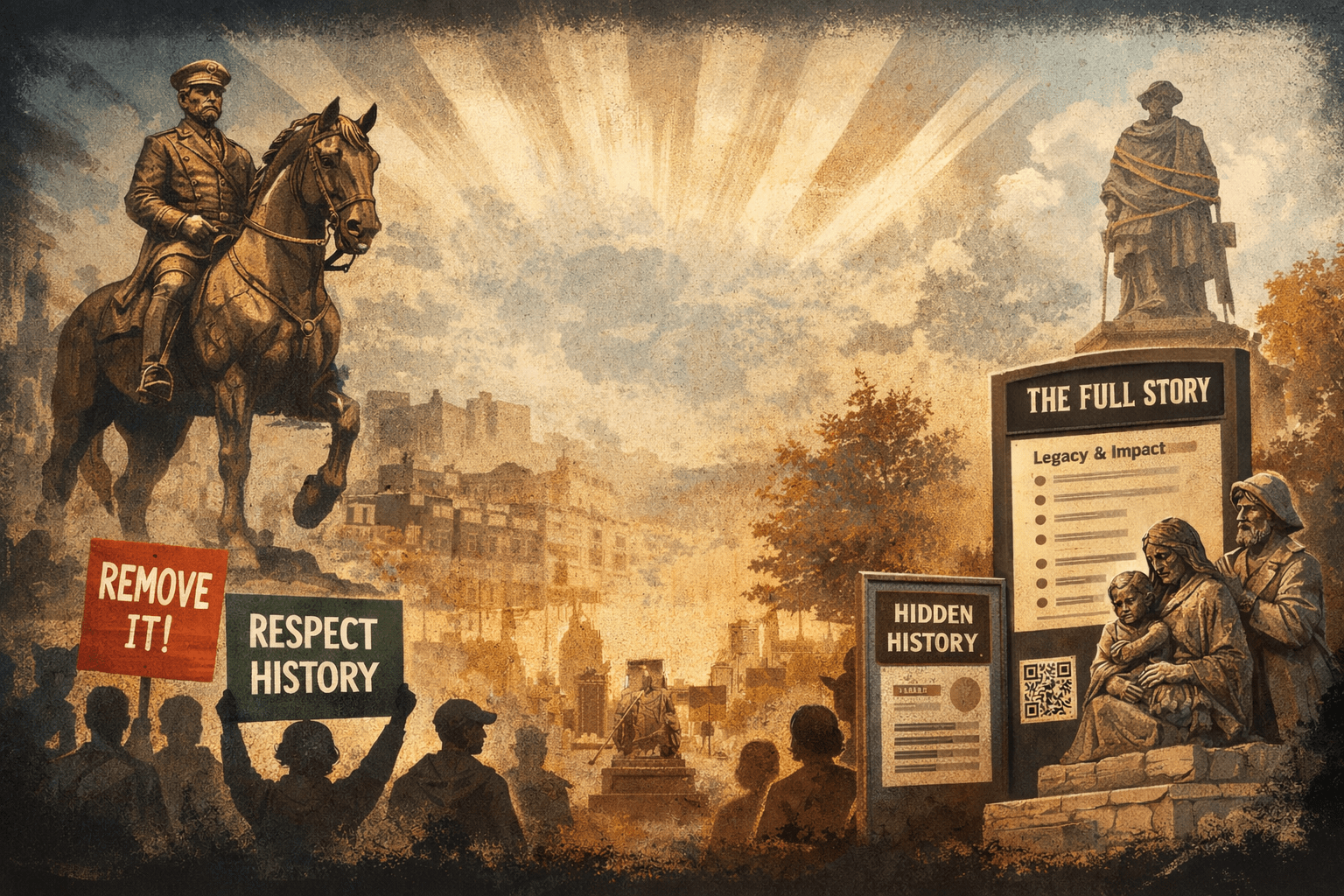
Statues, Controversy or Context?
Statues, Context, and the Stories We Pretend Are Neutral
We have been raised to believe a presented narrative and to treat statues as if they are history made solid. Bronze somehow equals truth. Stone can equal facts. In this belief lies the first problem. A statue is not a balanced documentary. It is not even a neutral marker of what happened. A statue is a public message, placed on purpose, by someone with authority or money, to say: this person, this idea, this version of events deserves honour.
That does not automatically make a statue inherently evil, but it does mean we should stop pretending statues are just harmless scenery. they are not…they are cultural billboards, and billboards are never accidental.
Why statues get messy, fast
Most public monuments are less about the past and more about the moment they were built. The question people skip over is the most revealing one:
Who commissioned it, and why?
Because a statue can be erected decades or even centuries after the person lived, usually when a community wants to reinforce a certain identity, comfort itself, or project power. That is why arguing it is history is often a dodge. It might be about history, but it was created to influence the present, and that is where statues become problematic:
- They elevate, they do not explain. A pedestal is not nuance. A heroic pose does not come with footnotes.
- They flatten a whole life into a visual image. Conqueror. Founder. Visionary. Great man or woman or person. Meanwhile, the damage disappears behind a proud jawline, a heroic stance, and sometimes a horse.
- They often represent one group’s memory as everyone’s memory. Public space is shared space. When one story dominates the landscape, other stories become invisible.
- They teach by omission. People will swear a monument is just honouring achievements, but leaving out the cost of those achievements is still a choice.
A statue does not need to say anything out loud to make a claim. The claim is built into its existence: this is who we celebrate.
The myth of context
Here is the twist: people tend to remove context from the equation so that critiques disappear.
Context is not…he/she/they were a product of their time.
Context is not…everyone did it back then.
Context is not…but he/she/they also built a hospital, founded a school, or did some good things.
Real context is the whole story, including the parts that do not fit comfortably on a plaque.
It means asking:
- What did this person do, and to whom?
- Who benefited from their choices, and who paid for them?
- What did this monument erase in order to take up space?
- Why was it put up when it was put up?
- Who decided this was the story that belongs to everyone?
When people say respect history, what they often mean is respect the version of history they used to seeing without the truth or uncomfortable bits.
Remove it, it is an answer but not the only one
There is a reason people argue about removal, and it is not because everyone suddenly “woke” and cannot handle the past. It is because public honour is a living thing. A statue in a square is not the same as a statue in a museum. One is a civic endorsement. The other is an artefact you can interpret, critique, and teach with.
Still, while removal is an option it is not the only option, and sometimes it is not the best one, because the real goal should not be to pretend history did not happen. The goal should be refusing to keep reenacting the same selective memory. However, if a community is not ready to create a more realistic timeline and story for a monument it should not be left in place without some context. What a community should be asking it’s population is
What purpose does this statue serve right now?
If the answer is it keeps reopening harm with zero explanation, then yes, the community has every right to rethink it. However, if the answer is it can become a teaching tool with the full story attached, then the community now has options that move beyond shouting matches. The issue is getting there. Yes there will be those that cry because the “original” aspect of the statue is now subject to scrutiny by all, but in order to facilitate real context the true history has to be applied.
How to add the whole story without sanitizing anything
If a community chooses to keep a controversial monument in a public space, it has an obligation to stop treating it like a shrine. That means adding interpretation that is honest, specific, and hard to wriggle out of. There are several ways to do that such as:
1) Replace or include plaques with the whole truth, warts and all. Vague complex legacy lines do not apply, neither does a polite dodge. A real summary should include:
- the achievements
- the harm
- the people impacted
- the historical debates
- why the statue exists in the first place
2) Add context in layers, not just one sentence
A small plaque is rarely enough. Use multiple elements, or pick one that can present the whole story effectively.
- interpretive panels
- a QR code linking to a detailed page with sources
- oral history clips or community testimony
- timelines that show what else was happening, and who was excluded
3) Create counter monuments
One of the most powerful solutions is not subtraction, it is addition. Instead of removing the problematic statue, put another nearby that offers the story that was erased:
- the people displaced
- the workers exploited
- the communities harmed
- the resistors, organizers, survivors
This turns a one note monument into a public conversation, and a learning experience.
4) Move it to a museum
Sometimes the right call is relocation, not destruction:
- place it in a museum or interpretive park
- present it as a historical artefact with context
- include who commissioned it, when, and why, and also how those ideas and views have changed over the years.
That preserves the object while removing the civic endorsement.
5) Let the community, not just officials, shape the interpretation
This part matters. Context written only by institutions is often just a variation of control.
These statues/monuments should Include:
- Indigenous voices
- descendants and impacted communities
- local historians
- educators
- artists and cultural workers
Not as a token. As co authors of the narrative.
What we are actually fighting about
Most statue arguments are not really about the piece itself. They are about identity and belonging.
Who gets to be the default hero?
Whose pain gets minimized?
Whose version of history becomes the “official” story everyone is expected to accept?
That is why people get so heated, because changing a monument feels like changing a story people were raised on, and some people confuse that discomfort with oppression, but here is the reality: a more honest public landscape does not erase history. It allows the history to become a real part of the future.
The simplest way to say it
Statues are not about history. They are decisions about who deserves honour in shared space. The people who are being cast in metal and stone are dead. They don’t care. Statues are for the living, and if we are going to keep them, we owe each other more than a heroic pose and a tidy myth. We owe each other the full story, the glorious parts, the ugly parts, and the human parts, so nobody has to live under someone else’s sanitized memory. A society that cannot handle nuance does not have heritage. It has propaganda with good lighting, and plenty of bird droppings.