The Myth of the “Perfect Find” (and What Archaeology Actually Looks Like)
If you’ve ever watched an archaeology documentary, you’d be forgiven for thinking the job is 90% dramatic discoveries and 10% squinting at dusty things while someone whispers, “This changes everything.”
Real archaeology is a little less cinematic… and honestly, far more interesting.
Because most of what we do isn’t about treasure. It’s about evidence, tiny, ordinary, easily-overlooked traces that, when handled properly, can tell you how people lived, what they valued, what they ate, what they feared, and what they carried with them through generations.
And the truth is: the “perfect find” is rarely the point.
Archaeology isn’t a scavenger hunt
The public image of archaeology tends to focus on objects…pots, coins, bones, jewelry. But the most valuable thing we recover is often something you can’t display in a case:
context.
Where something is found matters as much as what it is. A button in a layer of house fire debris, a scatter of ceramics near a water source, a nail concentration that outlines a structure you can’t see from the surface, those patterns are where the story lives.
Remove an artifact without recording its context, and it’s like tearing a sentence out of a book and trying to guess the whole plot.
The “boring” bits are actually the gold
Some of the most meaningful moments in the field happen when nothing flashy is happening at all:
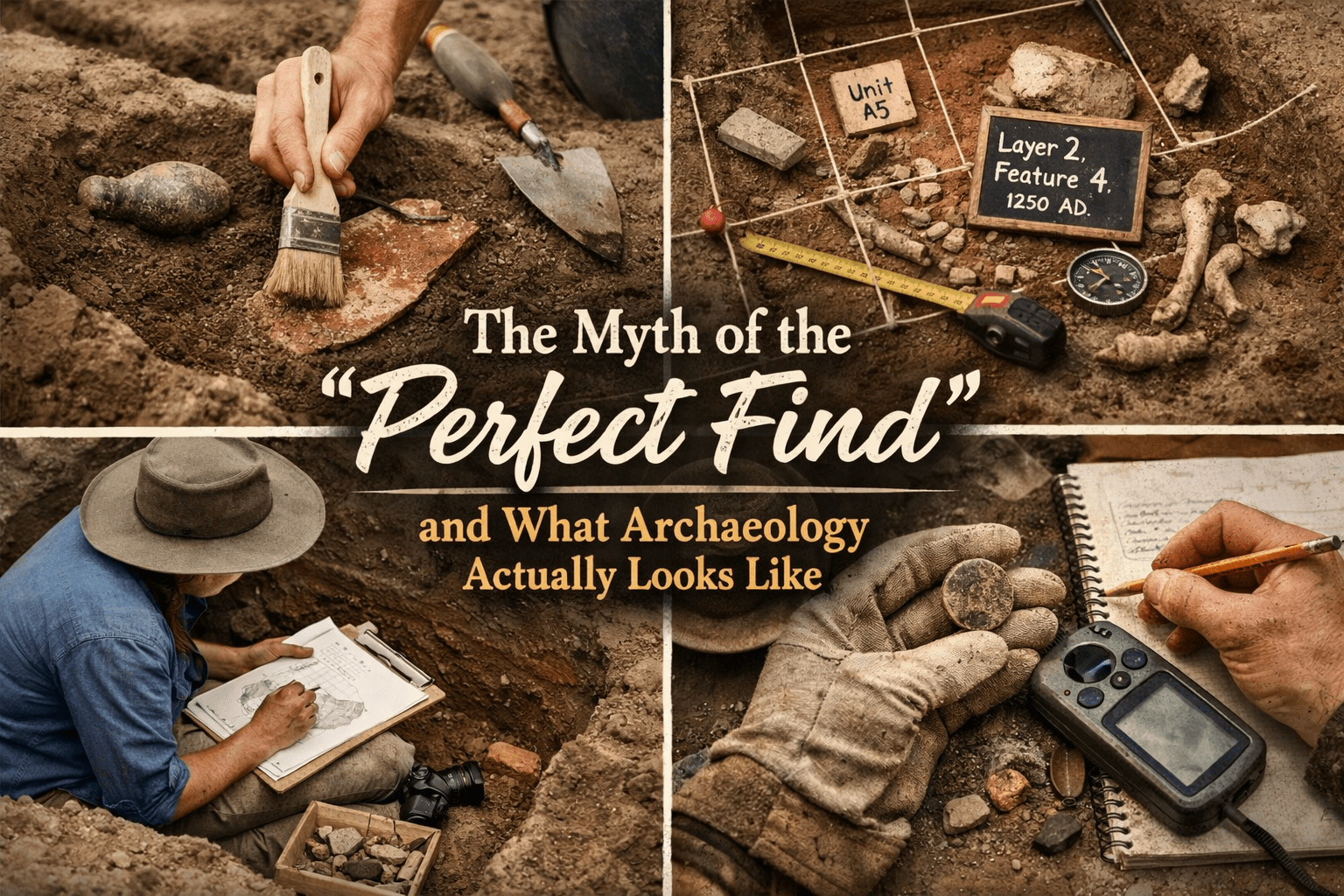
- carefully troweling down a level and watching a soil change appear
- drawing a profile so future researchers can see exactly what you saw
- bagging and labeling properly so the evidence stays usable
- catching a subtle pattern before it disappears in the next layer
It’s slow. It’s methodical. It’s deeply satisfying.
And it’s how archaeology stays honest.
Why provenience is everything
One of the words you’ll hear archaeologists use a lot is provenience (where an artifact was found in three-dimensional space). That information allows us to ask better questions:
- Was this object used here, stored here, lost here, or dumped here?
- Does it belong to daily life, ritual life, or a single unusual event?
- Is it part of a longer occupation—or a brief moment in time?
Without provenience, an artifact becomes just a thing. With it, it becomes evidence.
Archaeology is storytelling with rules
Yes, archaeology is a form of storytelling—but not the kind where we get to make the ending up because it sounds good.
We build interpretations using:
- excavation data
- stratigraphy
- artifact analysis
- comparison with other sites
- historical documents (when they exist)
- and a whole lot of “this is likely” instead of “this is certain”
Good archaeology isn’t about being dramatic. It’s about being careful.
What I wish more people knew
I wish more people understood that archaeology is not just “digging up the past.”
It’s protecting it, too.
Sites are non-renewable. Once disturbed, they can’t be put back the way they were. That’s why responsible excavation is slow, why documentation matters, and why “just looking” can still cause real damage.
If you love the past, the best thing you can do is help keep it intact.
So what should you do if you find something?
If you’re walking, hiking, gardening, metal detecting, exploring an old property, whatever it is, and you stumble on something that feels “historical,” here’s the safest approach:
- Don’t touch it, and don’t remove it.
- Take a photo where it sits (wide shot + close-up).
- Note the location as accurately as possible. What 3 Words is an excellent option.
- Contact a local museum, archaeologist, or heritage office for guidance.
You’re not “ruining the fun.” You’re protecting the story.