The Giant Myth and the Erasure of Indigenous Mound Builders
Giants in the Ground?
What archaeology actually finds, what it does not, and why the story matters
Every few months the same claim shambles back across social media. A “giant race” once lived here. Their skeletons were found in mounds. Someone swooped in and hid the evidence. Usually the villain is the Smithsonian, a museum, or some unnamed “they.”
As an archaeologist, I am not offended by big questions. I am offended by bad evidence. Archaeology is not built on screenshots, and social media posts. It is built on context. If something is real, you can document it, measure it, do one’s best to date it, compare it, and let other professionals examine it.
So here is the real question. Has anything archaeological and transferable ever been found that supports a giant race of people?
If by “giants” or a population of humans that are supposed to be eight to twelve feet tall, with enough numbers to leave cemeteries, settlements, and a material signature behind them, then no. Nothing credible has ever been produced in a way that survives basic archaeological scrutiny. If by “giants” that are tall individuals who have existed, then yes. Humans vary. Some people are exceptionally tall. They are not, however, a separate race.
Those are two very different claims, and the internet loves pretending they are the same.
What real evidence would look like
If a giant population existed, we would not be relying on a single over sized femur mentioned in a newspaper clipping from the 1800s. We would expect repeatable patterns across multiple sites, documented by multiple excavations, held in collections with catalog numbers and provenience. I one received an entire package of these “stories” collected up over the years including newspaper clippings, so called “photos” among other bits of paper attempting to convince me or anyone else willing to give them a look that “giants” existed. The problem was, and still is…not one of those articles, or dubious photos have any archaeological evidence to back them up. If I am looking for facts here is what I would need to take the claim seriously.
- Properly excavated human remains, recorded in place, with field notes, maps, photographs, and chain of custody.
- Secure dating. Not “ancient,” not “mysterious,” but actual dates from reliable methods.
- Osteological analysis by qualified specialists, with measurements and comparative data.
- Curated remains that can be re examined by other researchers. That is the transferable part.
- A pattern. Not one individual, but a population signal that shows up in burial grounds and in the broader archaeological record.
Bodies do not appear in isolation very often. Although Kennewick Man, Otzi and Anzick Child were stand alone remains, we also know that they are not unknown to their people. There is evidence, DNA, and other factors that connect them to their environment. If a whole group of giant humans existed, their lives would leave traces too. Tools scaled to their hands. Houses scaled to their bodies. Wear patterns, diet markers, trauma patterns, and cultural practices that repeat across regions and generations.
A real giant population would not be subtle.
What we actually have instead is a mix of storytelling, misidentification, and hoaxes.
Most people are often not trained in osteology. A large animal bone can look convincingly human if you already want it to be. Fragmentary remains get misread. Measurements get inflated. Stories get repeated until they feel like facts.
Then there are outright hoaxes, both historical and modern. Some were carved and toured for profit. Some were staged. In the internet era, many are simply photo manipulation, often traced back to edited contest images or recycled fakes.
When someone says “giant skeleton found,” my next question is always, “Where is it now?”
If the answer is, “They took it,” then we are not in archaeology anymore. We are in folklore. Who is “they”? Usually the answer is some convoluted attempt to claim that it is the government or people who don’t want anyone else to know because somehow the discovery would compromise current history. But, would it really?
Real discoveries leave a paper trail. Excavation records. Accession numbers. Repository data. Lab reports. People you can name. Collections you can re check, and people you can speak to who have lived on the land for thousands of years who carry their stories.
Smithsonian story, and why it collapses
So where did this all start?
Clearly it started with a certain amount of unintended ignorance as to what someone found. But…how did it actually end up becoming a conspiracy story that still makes it’s rounds today, surely, this would be finally put to rest.
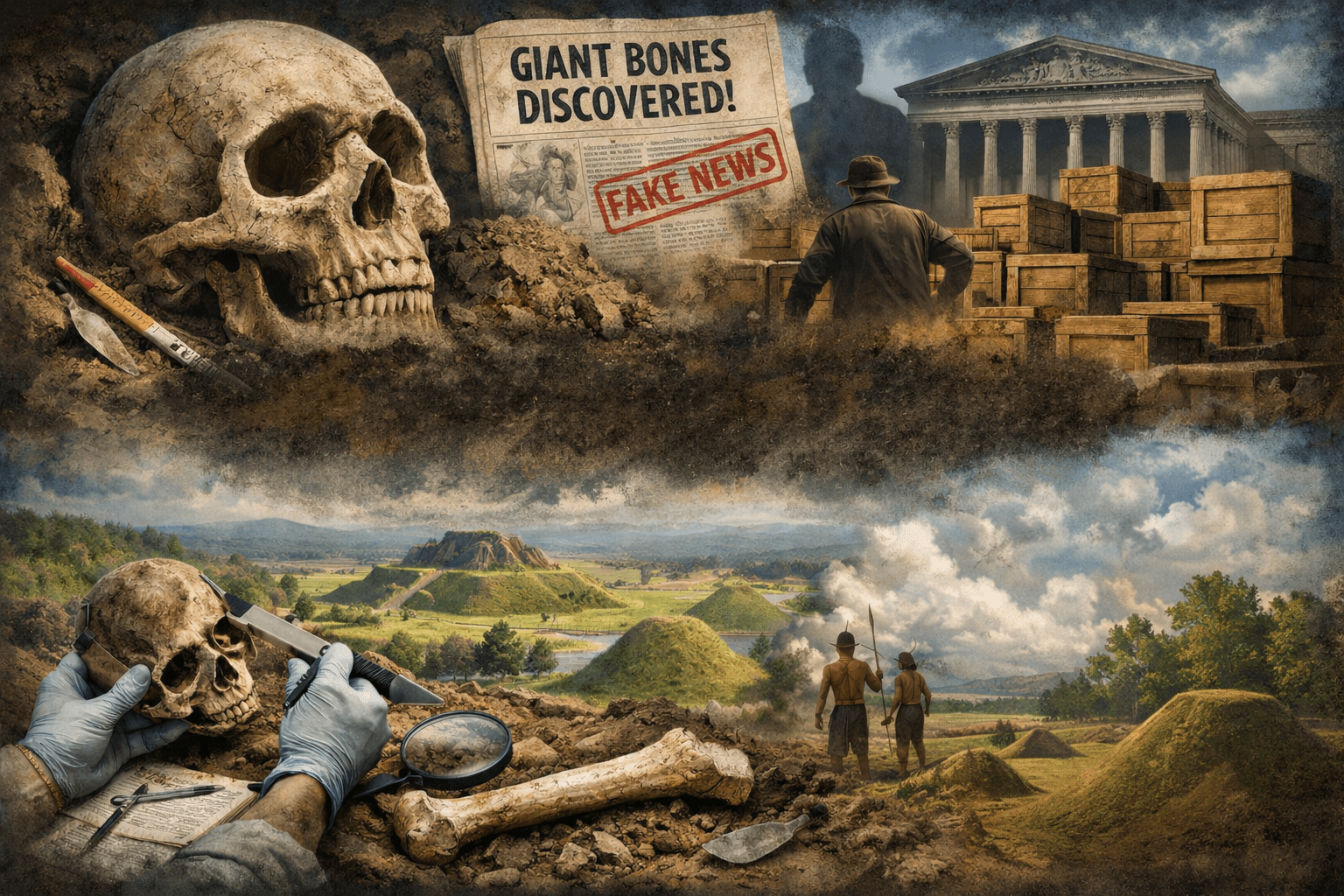
The Smithsonian conspiracy is the most repeated version because it gives the story a neat villain and offers believers a shortcut around evidence. The claim usually goes like this…The U.S. Supreme Court supposedly forced the Smithsonian to admit it destroyed thousands of giant skeletons in the early 1900s to protect mainstream history.
Here is the problem. That story is not a suppressed bombshell. It is a modern internet fabrication that was traced back to satire. There is no legitimate reporting of such a Supreme Court case, and it does not appear in Supreme Court records. The Associated Press addressed this directly and quoted a Smithsonian spokesperson calling the claim false and baseless. Reuters also traced the story back to a satirical site and noted the Smithsonian said it was not true. Snopes has been debunking versions of this for years as well. Even Smithsonian Magazine has addressed the myth plainly and credited it to a satirical source, stating the evidence never existed.
So when someone tells you, “The Smithsonian admitted it,” you can reply with something simple. They did not. The story is satire that went viral, and people keep reposting it because it feels satisfying. There is also an important ethical point here. The Smithsonian, like many institutions today, has been reevaluating how human remains are handled and returned under modern ethical standards. That is not a conspiracy. That is a long overdue shift toward accountability and respectful stewardship.
“But what about the mounds” and why this is not harmless
This is where the giants story stops being a goofy rabbit hole and starts doing real harm. A huge portion of the giant narrative is welded to an older myth, the idea that Indigenous peoples could not have built the major earthworks, mound complexes, and engineered landscapes across North America. That claim has a long history. It fed the so called Mound Builder myth, the argument that the builders must have been some vanished non Indigenous group, or giants, or Atlanteans, or anyone except the people whose descendants were still very much alive. The function of that story becomes obvious when you look at it plainly.
It strips Indigenous nations of authorship and expertise. It reframes sophisticated engineering as a mystery that must belong to outsiders. It encourages the public to see these places as disconnected from living Indigenous cultures. It keeps misinformation circulating that undermines education, heritage protection, and respect.
When someone says, “They were not capable,” or “They had no reason to build these sites,” they are not just misunderstanding the culture, they are misunderstanding the importance behind Indigenous stories, and the archaeological records. They are repeating a narrative that has historically been used to erase Indigenous ingenuity, sovereignty, and continuity.
The reality is the opposite. One thing the archaeological record does shows is planning, labour organization, long term use, ceremonial purpose, and deep environmental knowledge. Those are the fingerprints of complex societies doing what humans everywhere do, building meaningful places that connect community, cosmology, and land.
So when I push back on giants, it is not because I am allergic to mystery. It is because I am loyal to evidence, and because I am not interested in recycling a story that, intentionally or not, keeps Indigenous history at arm’s length from Indigenous people, and from the general public.
So, has archaeology ever found anything at all that could be called “giant”
If we are being precise, archaeology has found tall individuals, just like every era does. Humans have always varied in height, shaped by genetics, nutrition, health, and environment. That does not equal a separate race. It does not equal a lost civilization. It does not equal a secret history. What the giant story requires is a pattern. That is the part that never shows up in a credible way.
A quick reality check you can use
When you see a “giant skeleton” post, ask four questions.
- Where exactly was it found, and who excavated it.
- Where is the documentation, including field notes and provenience.
- Where is the osteology report, including measurements and comparative analysis.
- Where is the curated collection, and can it be re examined by qualified researchers.
If those answers are missing, vague, or replaced with “they took it,” you have your conclusion. It is not archaeology. It is content.
I understand why people love the giant story. It feels like forbidden knowledge. It feels like the world is bigger and stranger than the textbooks say, but archaeology is already bigger and stranger than most people realize, and it does not need invented skeletons to be interesting. Real Indigenous engineering is extraordinary. Real human variation is extraordinary. We do not need a fake Supreme Court case and a satirical headline that has passed it’s “Sell by date” to make the past compelling.
If someone ever produces properly documented remains, with secure provenience, solid dating, qualified analysis, and a collection that can be re examined, then archaeology will do what it always does. It will test the claim. Until then, the “giant race” narrative remains what it has always been. A mix of hoax, misunderstanding, and storytelling that too often props itself up by denying Indigenous peoples the credit and continuity they have always deserved.
If you want to talk about the real mystery, talk about why we keep needing giants to explain Indigenous brilliance. That question is far more revealing than any viral photo.
If you want to help dispel the myth, here are a few simple ways to do it.
- Pause before you share. If a post has no excavation report, no provenience, no catalog number, and no repository, it is not archaeology. It is a story.
- Ask better questions out loud. Comment with, “Where is the documentation,” “Where is the collection,” and “Who did the analysis.” You do not need to argue. You just need to bring it back to evidence.
- Stop repeating the Mound Builder myth in new packaging. Any claim that depends on Indigenous peoples being incapable, or having no reason to build, is not neutral. It is the same old erasure, and dare I say it…racism, dressed up as a mystery.
- Share the correct framing. These sites are not leftovers from a vanished people. They are part of living Indigenous histories, with descendants who are still here.
- Learn from Indigenous led sources when you can. If a site has interpretation written with local Indigenous nations, read that first. If a community has public education pages, talks, or statements, boost those instead of the conspiracy threads.
- Support protection, not spectacle. A lot of misinformation feeds looting and disrespect. Encourage people to visit responsibly, follow site rules, and treat these places as cultural landscapes, not treasure maps.
- If you are unsure, say you are unsure. There is nothing weak about that. It is how we learn and where real research works.
As an archaeologist, I am not here to police curiosity. I am here to point curiosity in a direction that does not erase the people who built these sites. If we care about the past, we should care about getting it right, and about who gets written out.