Pyrates, Powder, and Victory at New Orleans
Laffite’s Edge at New Orleans
As a battlefield archaeologist, I am drawn to the Battle of New Orleans because the Baratarian story sits at the exact point where myth can be tested against material and documentary evidence. Jean Laffite and his circle have been turned into folklore, but the campaign record and the landscape that remains allow a more disciplined question. What, specifically, did the Baratarians contribute that could plausibly affect the outcome.
The site is not intact. Industrial expansion and modern landscape change have removed large portions of the original ground. Even so, enough remains to keep the narrative accountable. The American line and the canal corridor still provide orientation, and there is a recoverable material record consistent with a defended position that relied heavily on sustained fire. That matters, because the Baratarian contribution, stripped of romance, is best described as support to the elements that decide defensive battles. Intelligence, munitions, and competent gun crews.
Setting the stage, from the Baratarian point of view
Chalmette was a working plantation landscape. Cane fields, drainage ditches, narrow roads, and the river margin shaped visibility and movement. For a coastal operator, that terrain was not background. It was the operating system. Laffite’s advantage was not that he designed the battlefield. It was that he understood routes, timing, concealment, and the practical limits of moving people and matériel through a controlled landscape.
Laffite’s contributions in this phase fall into three categories.
First, intelligence. When the British attempted to recruit him, he converted that approach into actionable information for the American side. That is not inference. It is the logic of direct contact. He knew what was being offered and what was being planned because he was part of the conversation.
Second, logistics. The Baratarian network existed to move goods under pressure. That skill set translates directly into wartime conditions. Powder, flints, shot, and small arms are not abstractions in a defensive battle. They are the difference between batteries that maintain rate of fire and batteries that slow or stop.
Third, personnel. The Baratarians were not simply bodies. They were crews accustomed to artillery routine in maritime contexts: powder discipline, coordination, and the ability to keep a gun in action under stress. In a defensive system where artillery performance shapes the tempo of the engagement, trained crews are a measurable form of combat power.
Jean Laffite
Jean Laffite’s role is documented within the campaign record as intelligence and liaison work. In December 1814, Jackson’s correspondence refers to Laffite offering to go down and provide information, with instructions that he be protected and returned quickly because he would be needed. That places Jean in the operational story during the formation and holding of the line, not as a symbolic figure added later.
Claims about whether Jean personally served a gun on the morning of January 8 are less important than the contribution the documentation supports. In a campaign constrained by time and supply, intelligence gathering, communication, and logistics coordination are not secondary tasks. They are enabling tasks that allow the defensive system to function.
Pierre Laffite
Pierre Laffite is best understood as the New Orleans facing side of the operation. He appears in the city context where networks, contacts, and the movement of goods intersect with law enforcement pressure and wartime need. Pierre’s importance is structural. Baratarian activity depended on relationships and reliable channels between the bay and the city. Pierre represents that interface.
Dominique Youx
Dominique You, often spelled Youx, is one of the Baratarians most clearly tied to artillery service during the campaign. Accounts describe him as a trained gunner prior to his Baratarian period and associate him with service in French forces during the Revolutionary and Napoleonic era, including connection to the 1802 Leclerc expedition to Saint Domingue. His significance in this essay is not biographical colour. It is functional. Skilled artillery personnel are critical in a defensive battle where the outcome depends on consistent, accurate fire from prepared positions.
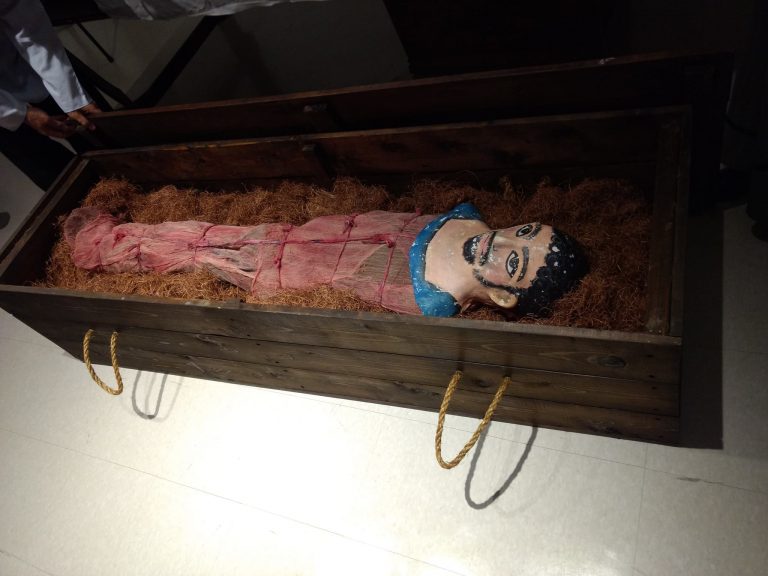
After the campaign, Dominique Youx remained in New Orleans. His later civic standing is documented through his Masonic affiliation, the military character of his funeral, and his burial in St. Louis Cemetery No. 2. These later facts matter to archaeology because they represent a material afterlife of wartime service: commemoration, inscription, and placement within a city landscape.
Renato Beluche
Renato Beluche provides a second, independent example of Baratarian competence with a documented background. Born in New Orleans in 1780, he went to sea early, appears in records tied to Spanish naval service by 1802, and later moves into privateering. The Napoleonic connection is properly framed as an environment rather than a personal uniform. Beluche comes up in a militarized Atlantic where blockade, privateering, and coastal warfare rewarded logistics, discipline, and gunnery skill.
Beluche’s later association with the wars of independence in South America and with Simón Bolívar’s cause extends his profile beyond local legend. It shows a career that continues in revolutionary warfare and helps explain why the Baratarian artillery contribution at New Orleans should be treated as a transfer of skill, not an anomaly.
Marc Laffite
Marc Lafitte enters the story for a different reason: documentation. A notary public named Marc Lafitte appears in New Orleans records in the early nineteenth century. The confusion around the Laffite family stems from multiple family trees available for reference. The similarity in names and whether or not those individuals are tied by kinship often comes into context, however, there is a very clear genealogical trail for Jean Laffite’s family. The presence of Marc’s name in the legal and commercial machinery of the city is relevant. It reinforces that this network operated through contracts, transactions, and paperwork as much as through clandestine movement. For a battlefield archaeologist, that is part of the evidentiary environment. People leave traces in soil, but they also leave traces in archives.
Where Jackson and Laffite converge
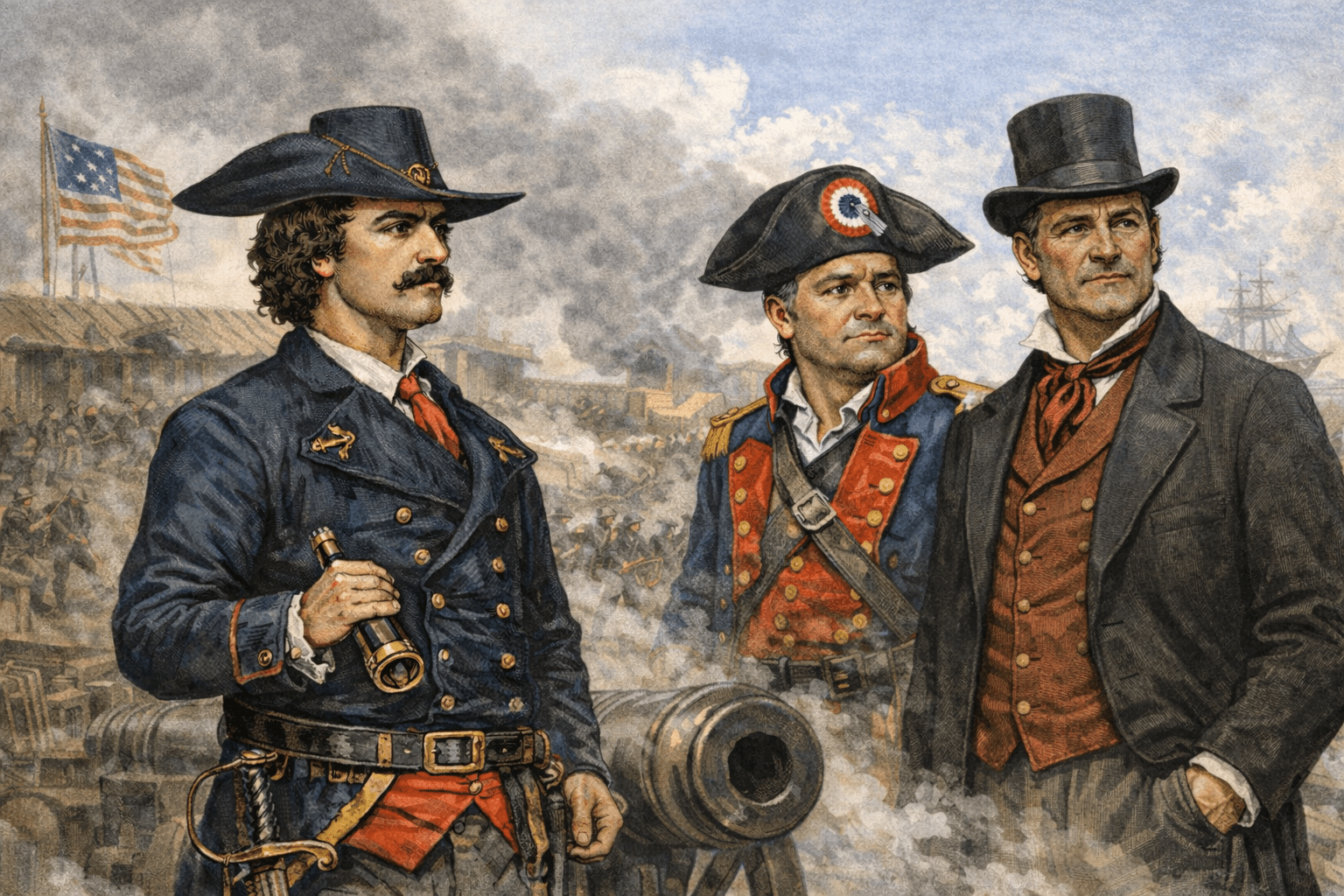
The Jackson – Laffite connection is best described as a wartime convergence of interests rather than a sentimental alliance. Laffite was legally vulnerable and operationally valuable. Jackson needed intelligence, munitions, and skilled hands quickly. The campaign record shows Jackson treating Laffite’s offer of information as useful and time sensitive. The relationship is therefore most accurately framed as transactional and strategic.
Artillery and outcome
In the run up to the main assault, the British attempted to reduce the defensive line with forward gun batteries before committing to a large infantry attack. Counter battery fighting is an arena where competence is measurable. Rate of fire depends on coordinated routine. Ammunition handling depends on discipline and workflow. Accuracy under smoke and stress depends on trained correction and steadiness. When gun crews lose rhythm, they slow, and when they slow they become easier to suppress.
This is the point where the Baratarian contribution aligns with battlefield logic. If Baratarian crews helped keep key batteries effective, then they strengthened the most outcome shaping component of the defense: sustained artillery performance from prepared positions.
January 8
On the morning of January 8, the British assault advanced into concentrated cannon and musket fire. British casualties were heavy and senior commanders were lost. The Baratarians did not construct the earthworks and they were not the only experienced gunners present. Their significance is narrower but still meaningful. They were integrated into the artillery system and valued for gunnery competence in a battle where guns that kept firing mattered.
Archaeology on the ground
A significant portion of the original battlefield landscape has been altered or removed, and interpretation must account for modern disturbance and changing land use. At the same time, the remaining features allow the core tactical narrative to be evaluated. The American line and canal corridor still structure spatial understanding. Artillery signatures are often expressed through distributions: shot scatters, impact patterns, and the expected geometry of canister and grapeshot. Small finds such as gunflints, musket balls, and uniform hardware provide localized indicators of presence and movement. The overlap of material from militia, regulars, naval detachments, and Baratarian associated personnel is consistent with a composite defensive line.
Summary
No single factor “wins” the Battle of New Orleans. The British defeat reflects the combined effects of a strong prepared position, concentrated fire, and breakdowns in assault timing under heavy casualties. Within that larger structure, the Baratarian contribution is not best treated as legend. It is best treated as targeted reinforcement of the defense’s most critical requirements: intelligence, supply, and artillery competence. That is why the site remains compelling even in a disturbed landscape. It supports a disciplined reading of how a network of pyrates became, briefly, a practical military asset.